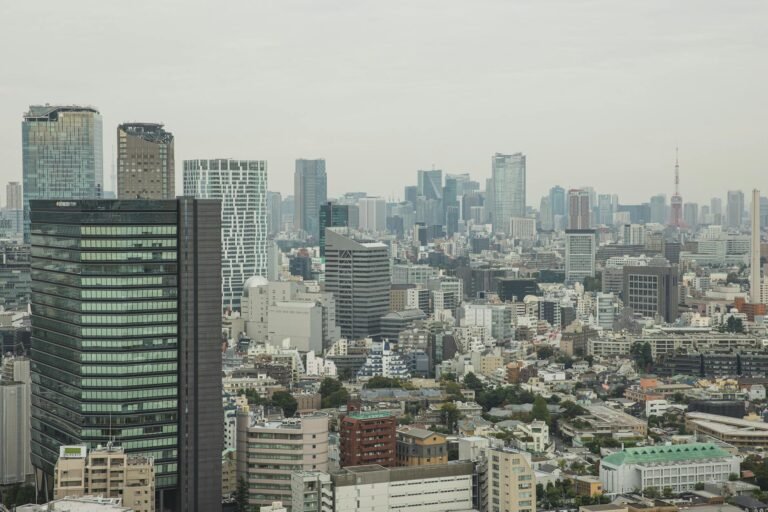
Japan’s population peaked in 2008 at roughly 128 million. It has been declining ever since.
By 2050, projections put it under 100 million — losing roughly 28 million people in 42 years. The working-age population (15-64) is declining even faster. The Japanese government’s own estimates suggest the country will be short several million workers by the end of the decade.
This is not a story most Western professionals are tracking. It is one of the largest economic shifts in any G7 country, and it is creating a structural opportunity for foreign talent that did not exist a generation ago.
THE POLICY RESPONSE
Japan has historically been one of the most restrictive countries in the developed world for foreign workers. As recently as 2018, the framework for non-Japanese professionals was narrow, complicated, and informally hostile to permanent settlement.
That has changed.
The 2019 Specified Skilled Worker (SSW) visa categories opened pathways into 14 industries facing acute labor shortage — construction, agriculture, nursing care, food service, manufacturing, hospitality, and others. The 2023 expansion of SSW Type 2 created routes to permanent residency for skilled foreign workers in those sectors.
The Highly Skilled Foreign Professional visa was simultaneously made more accessible. Points-based, fast-tracked, and explicitly aimed at recruiting senior international talent — engineers, researchers, executives, entrepreneurs.
The J-Find and J-Skip visas, introduced in 2023, target recent graduates from top global universities and high-earning specialists. The message from the Japanese government is consistent across these reforms: come work here, we are no longer making it complicated.
THE QUIET OPPORTUNITY THIS CREATES
Most foreign professionals are still operating on a 2010-era understanding of Japan. The country was difficult to work in. Permanent settlement was rare. Companies were closed-door, monolingual, and skeptical of non-Japanese leaders.
That model is now mismatched with reality. Japanese companies are actively hiring foreign talent at every seniority level. Tokyo, Osaka, and Fukuoka all have growing English-functional professional ecosystems. The global mobility consultancies that monitor cross-border talent movement consistently report Japan as one of the highest-growth destinations for foreign hires in the late 2020s.
The professionals who recognize this shift early are positioning for ten-plus years of compounding advantage.
WHAT THIS MEANS FOR LANGUAGE
Japanese language ability is the single highest-leverage skill for capturing this opportunity.
Most foreign hires who arrive in Japan with no Japanese reach an effective ceiling within two to three years. The roles available without Japanese ability are largely confined to fully English-functional teams at multinational subsidiaries. The roles where the actual work happens in Japanese — strategy, negotiation, internal politics, partnerships — are inaccessible without language.
Foreign professionals who arrive with conversational Japanese are routed to a fundamentally different set of opportunities. Foreign professionals who arrive with business-functional Japanese (keigo, meeting structures, written correspondence) are competitive for roles that command 30-50% higher compensation than their English-only equivalents.
The differential compounds over a career.
For professionals starting that relocation, the first practical step is also the first daily-Japanese drill. A Sakura Mobile eSIM with an included Japanese phone number is what unlocks every keigo-heavy phone call relocators run into in their first week: opening a bank account, registering at city hall, confirming a residence card pickup. The forms are formal Japanese. The phone calls are formal Japanese. Both are real-world drills the moment your number is active.
THE TIMING
This window will not stay open forever in its current form.
As Japan’s labor shortage stabilizes — through automation, productivity gains, or a stabilized foreign workforce — the policy bias toward foreign recruitment will moderate. The current visa generosity is a response to crisis, not a permanent stance.
Our read of the policy environment: the next five to seven years are likely the most accessible window in modern Japanese history for foreign professionals to establish careers in the country. After that, reforms will not necessarily reverse, but the desperation that motivates the current openness will ease.
Professionals who learn Japanese during this window are positioning for a career advantage. Professionals who wait will face the same opportunity at a higher difficulty setting — more competition, less institutional support, narrower pathways.
THE UNCOMFORTABLE OBSERVATION
This is not the kind of opportunity most career advisors are talking about. Japan does not have the cultural mindshare in Western professional circles that China did in the 2010s, or that the UAE has had recently. The talent market is responding to the demographic reset, but the public conversation has not caught up.
That gap is the opportunity. The professionals who notice it early have access to a thinner, less crowded competitive field than they will in five years.
Were you tracking this shift, or is it new to you?