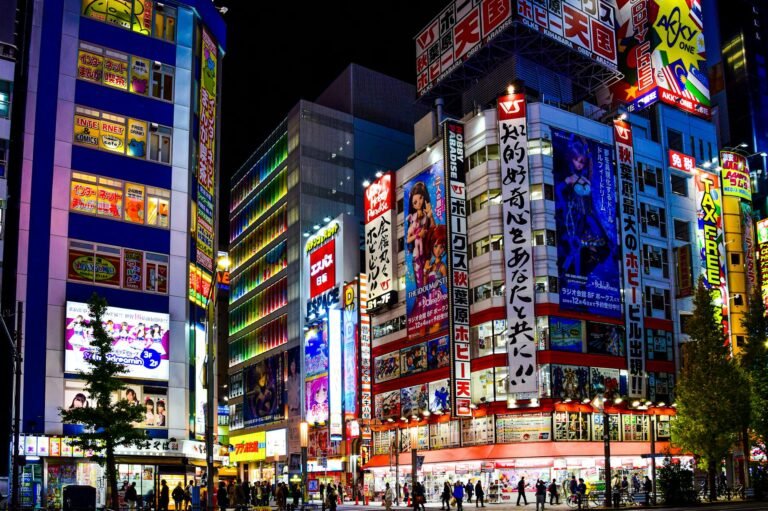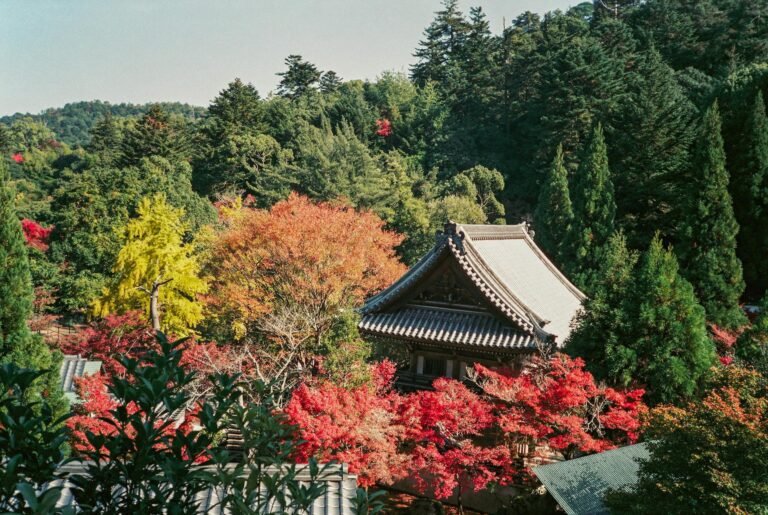
You had the trip of a lifetime. Two weeks in Japan. Temples in Kyoto that made you forget what century you were in. A bullet train so smooth you could balance a coin on the tray table. Ramen that ruined every bowl you’ll ever eat at home.
And somewhere in the middle of all that — maybe at a ticket machine in Osaka with a line forming behind you, maybe at a tiny ramen counter where the chef asked you something and you had absolutely no idea what he said, maybe standing in an onsen changing room staring at a wall of Japanese text trying to figure out the rules before you accidentally offended everyone — something clicked.
I should have learned some Japanese before I came here.
And now you’re home. The jet lag is gone. The photos are posted. But that feeling hasn’t faded. If anything, it’s gotten louder. You keep thinking about the conversations you didn’t have. The side streets you didn’t explore because there was no English menu in the window. The moments where you pointed, smiled apologetically, and wished you could have done more.
You’re not alone in this. Not even close.
You were one of 37 million people who felt the same thing
Japan’s tourism boom isn’t slowing down. In 2024, the country welcomed roughly 36.9 million foreign visitors — a 47 percent jump from the year before, and well past the pre-pandemic record. Over 2.7 million of those visitors came from the United States alone. Another 688,000 from Canada. By the end of 2025, the annual total crossed 42 million.
Most of those people had a similar experience to yours. The Japan Tourism Agency surveyed thousands of international travelers at major airports, and the data paints a clear picture: about 15 percent reported serious difficulty communicating with staff at restaurants, shops, and transit stations. Nearly 11 percent struggled with signage that was either missing English entirely or printed so small it was useless. Over 12 percent got lost or confused navigating public transportation.
And those are just the people who reported it. The real number — the people who quietly pointed at pictures, used Google Translate with mixed results, and powered through on nervous smiles — is almost certainly much higher.
The moments that stick with you
The frustrations tend to cluster around a few specific experiences. You probably recognize at least one of these.
The train station that broke your confidence
If you stayed inside the Yamanote Line in Tokyo or stuck to the main Osaka loop, you were fine. Color-coded maps. English announcements. Digital displays you could read. It felt manageable.
The moment you ventured beyond that — a regional train to a smaller city, a rural bus, a transfer at a station you’d never heard of — the scaffolding disappeared. Suddenly the signs were Japanese-only. Your reserved Shinkansen ticket was printed entirely in kanji, and all you could decipher were the numbers. The platform announcement was fast, clipped, and completely opaque.
Transit researchers have documented this exact problem. They call it the “Foreign Language Display Problem” — English translations, when they exist at all, are often too small to read, inconsistently translated, or missing entirely for secondary information that was added after the original signage. Different rail companies use different map styles, different wayfinding logic, different visual systems. You can master one network and feel completely lost on another.
You stood there, phone in hand, Google Maps open, hoping the blue dot would save you. And it usually did. But the stress of it — the cognitive load of being perpetually one wrong platform away from a two-hour detour — wore you down in a way the guidebooks never warned you about.
The restaurant you walked past
You wanted to eat where the locals eat. Not the tourist spots with laminated English menus and photos of every dish. The little izakaya down the alley with the steamed-up windows and the handwritten menu on the wall.
But you didn’t go in.
Maybe because you couldn’t read the menu. Maybe because you were afraid of holding up the line while you fumbled through a translation app. Maybe because you’d heard about places that don’t serve foreigners and you didn’t want to risk the awkwardness.
Here’s what most travelers don’t understand about those “Japanese Only” signs: the vast majority aren’t about xenophobia. They’re about economics and exhaustion. A tiny izakaya with eight seats and a single elderly owner operates on razor-thin margins, kept alive by regulars who understand the unwritten rules — order a drink per person, keep ordering small plates, pay the otoshi (a mandatory seating charge that includes a small appetizer). When tourists who don’t know these norms take up seats for two hours nursing a single beer, it threatens the business. And the owner doesn’t have the English to explain any of this politely.
The language barrier doesn’t just lock you out of restaurants. It locks you out of understanding why you’re being locked out. And that misunderstanding — on both sides — is one of the saddest casualties of the communication gap.
Meanwhile, in the tourist zones, you noticed the prices. A seafood bowl in Toyosu for 7,000 yen — close to $45 USD. Five times what a local would pay at a neighborhood spot ten minutes away. But you couldn’t find the neighborhood spot. You couldn’t read the signs. So you paid the tourist price and moved on.
The onsen where you held your breath
Nothing in Japan strips away your comfort zone quite like an onsen.
You walked into a changing room marked only with kanji — 男 for men, 女 for women — and a colored curtain that you really hoped you were reading correctly. You undressed completely (no swimsuit, that’s the rule). You carried a tiny towel that you were somehow supposed to keep out of the water at all times. You sat on a small stool and washed thoroughly before entering the bath, because getting in dirty is a serious violation. You kept your hair tied up so it wouldn’t touch the surface. You avoided sitting near where the fresh water flows in, because hogging the clean stream is considered rude.
You knew some of this from a blog post you’d read on the plane. But the finer points — the etiquette that was posted on the wall in Japanese, the quiet correction from another bather that you couldn’t quite parse — left you in a state of low-grade panic for the entire experience.
The hot water was incredible. The anxiety was not.
What’s actually happening in your brain during these moments
There’s a reason you froze at the ticket machine. A reason your mind went blank when the chef spoke to you. It’s not that you’re bad under pressure. It’s biology.
When you’re standing in a foreign environment, surrounded by a language you can’t process, with a line of impatient commuters behind you, your nervous system shifts into protection mode. Your brain prioritizes survival over complex thinking. The parts responsible for social engagement, language processing, and nuanced communication get throttled. You can’t think clearly because your body has decided this is a threat, and it’s redirecting resources accordingly.
That’s why the “freeze” feels so total. It’s not a character flaw. It’s a stress response.
And here’s the important part: back home, in a calm environment with no queue behind you and no waiter staring expectantly, that freeze doesn’t exist. Your brain is fully online. Your capacity to learn, process, and practice is completely restored. The version of you sitting on your couch right now is neurologically capable of doing everything the version of you in Shinjuku Station couldn’t.
The trip showed you the gap. Home is where you close it.
The motivation you’re feeling right now is real — but it’s temporary
This is the part no one talks about.
You’re fired up. You’ve already thought about downloading an app, buying a textbook, maybe signing up for a class. The emotional charge from the trip is still fresh. You can still feel the frustration of pointing at the menu, the embarrassment of boarding through the wrong bus door, the longing for the conversations you couldn’t have.
That fire is real. But research on adult language learning motivation says it fades — usually within a few weeks, as the distance from the trip grows and the daily grind reasserts itself. The initial excitement collides with the reality that Japanese grammar works nothing like English, that kanji requires months of sustained effort, and that there are no shortcuts.
The people who succeed at this aren’t the ones with the most motivation. They’re the ones who build a structure that survives the day their motivation disappears.
That means small, daily habits attached to things you already do. Ten flashcards while your coffee brews. A Japanese podcast during your commute. A fifteen-minute review session before bed. Not a heroic two-hour study block on Saturday that you’ll abandon by month two.
It means studying with a real person — not because an app can’t teach you vocabulary (it can), but because a scheduled lesson with a human being is the one commitment you won’t skip when your willpower is low. You’ll cancel on an app. You won’t cancel on a person who’s waiting for you.
And it means connecting the language to the thing that made you care in the first place. If the trip is what lit the fire, then the language has to stay connected to the trip. Study the words you wish you’d known at the ramen counter. Learn the phrases that would have helped at the train station. Read about the cultural norms that confused you at the onsen — in Japanese, even if it’s slow, even if you need a dictionary for every other word. Keep the language tethered to the experience that made you want it.
You don’t need to become fluent before your next trip
Let’s be clear about what’s realistic and what’s not.
If you can dedicate three to five hours a week to consistent study — some self-study, some time with a tutor — you can reach a point within a few months where your next trip to Japan feels fundamentally different. Not fluent. Not reading novels. But functionally different.
You’d be able to read hiragana and katakana, which means train station names and menu items suddenly become legible instead of decorative. You’d know how to order food, ask for the bill, say thank you in a way that actually sounds right. You’d be able to ask a simple question at a ticket counter and — critically — understand enough of the answer to act on it. You’d walk into that izakaya down the alley and know how to say “Is it okay if I sit here?” instead of hovering at the door. You’d book a tea ceremony experience in Tokyo and actually follow the instructor’s Japanese.
That’s not fluency. But it’s the difference between being a spectator and being a participant. And from everything the research shows, that’s exactly the difference that matters to people like you.
The trip was the starting line
You didn’t fail in Japan. You did what 37 million people did — navigated one of the most complex, monolingual societies on Earth with nothing but a smartphone and good intentions. That takes more courage than most people give themselves credit for.
But you felt the gap. You know what it cost you — not in money, but in connection. The conversations that didn’t happen. The places you didn’t go. The version of the trip that was right there, just on the other side of a language you didn’t speak.
That version is still available. It’s waiting for you the next time you go back. Start with the basics: grab an Airalo eSIM so you have data the moment you land, and start studying now so you have the words to use it.
Start now, while the feeling is still fresh.
Tabiji Academy teaches Japanese one-on-one with a native-speaking instructor — structured for adults, paced for real life, and designed to get you from “pointing at the menu” to “ordering in Japanese” faster than you think. Your first lesson is a free consultation where we figure out exactly where you are and where you want to go.