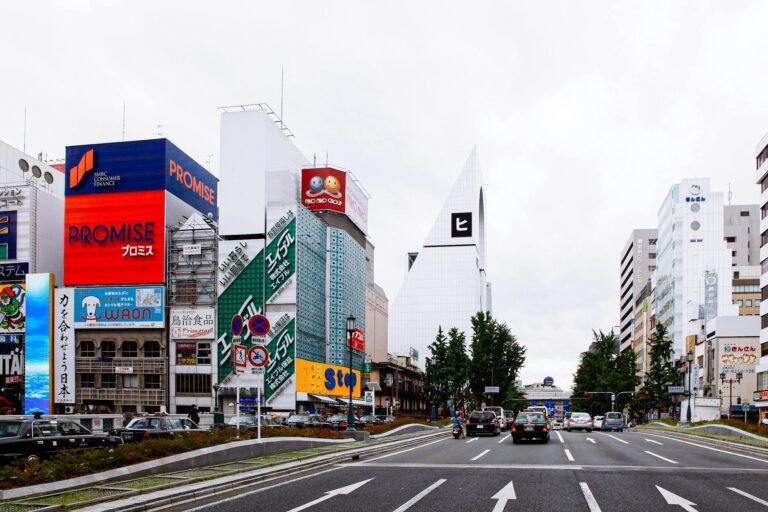
You are standing on a narrow residential street in Shimokitazawa. The lane curves past a cluster of wooden houses, a vending machine glowing softly in the dusk, and a cat sitting on a wall with more confidence than you feel right now. Your phone died ten minutes ago. The signs around you are entirely in Japanese. You need to find the station, and nobody within eyeshot appears to speak English. This is the moment where a handful of Japanese direction words become the most useful thing you have ever learned.
Asking for and understanding directions in Japanese is one of the most immediately practical skills a traveler can develop. Japan welcomed a record 42.7 million international visitors in 2025, according to the Japan National Tourism Organization, and while the country’s train system is famously efficient, the spaces between stations — the backstreets, the residential blocks, the unnamed lanes — are where most travelers find themselves quietly lost. What follows is a working vocabulary for navigating those moments with clarity and composure.
The Core Direction Words
These are the foundation. Learn these six words and you can decode the majority of directions anyone gives you on the street.
Ready to speak Japanese with a real person?
Book Your First Lesson — $55- 右 (migi) — right
- 左 (hidari) — left
- まっすぐ (massugu) — straight ahead
- 前 (mae) — in front / ahead
- 後ろ (ushiro) — behind
- 向こう (mukou) — over there / the other side
When someone gives you directions in Japanese, these words form the skeleton of every response. You will hear them combined with action verbs: 右に曲がってください (migi ni magatte kudasai) — “please turn right.” Or まっすぐ行ってください (massugu itte kudasai) — “please go straight.” The verb changes, but the direction words stay constant. Anchor yourself to them.
Landmark Vocabulary: The Words That Orient You
Directions in Japan are almost always given using landmarks rather than street names. This is not a quirk — it is the logical result of a country where the vast majority of streets have no names at all. Only major thoroughfares and famous shopping streets carry names like Meiji-dori or Takeshita-dori, and even those names are never used in formal addresses. So when a local tells you how to get somewhere, they are going to reference physical landmarks. Here are the ones you will hear most often.
- 交差点 (kousaten) — intersection
- 信号 (shingou) — traffic light
- 角 (kado) — corner
- 橋 (hashi) — bridge
- 坂 (saka) — slope / hill
- 通り (toori) — street / road
- 横断歩道 (oudanhodou) — pedestrian crossing
A typical set of directions might sound like this: 次の信号を右に曲がってください (tsugi no shingou wo migi ni magatte kudasai) — “please turn right at the next traffic light.” Or: 橋を渡って、左に曲がってください (hashi wo watatte, hidari ni magatte kudasai) — “please cross the bridge, then turn left.” Even if you cannot catch every word, recognizing 信号 or 橋 in the stream of speech tells you what to look for.
Asking “Where Is ___?”
The single most useful phrase structure for navigation in Japanese is remarkably simple.
___はどこですか? (___wa doko desu ka?) — “Where is ___?”
Drop any noun into the blank. 駅はどこですか? (eki wa doko desu ka?) — “Where is the station?” トイレはどこですか? (toire wa doko desu ka?) — “Where is the restroom?” コンビニはどこですか? (konbini wa doko desu ka?) — “Where is the convenience store?”
If you want to ask about a specific place by name, the structure stays the same: 東京タワーはどこですか? (Toukyou tawaa wa doko desu ka?) — “Where is Tokyo Tower?” You can also use the slightly more polite form: すみません、___はどこですか? (sumimasen, ___wa doko desu ka?) — “Excuse me, where is ___?” Starting with すみません (sumimasen) signals politeness and gets attention without being intrusive. Most Japanese people will stop and genuinely try to help you, even if they need to use gestures to bridge the language gap.
Understanding the Response: Distance and Time
Once you ask, you need to understand the answer. Many responses will include an estimate of distance or walking time. These are the key words to listen for.
- 近い (chikai) — close / nearby
- 遠い (tooi) — far
- すぐ (sugu) — immediately / right there
- 分 (fun / pun) — minute(s)
- メートル (meetoru) — meter(s)
- 歩いて (aruite) — on foot / walking
You will frequently hear constructions like 歩いて五分ぐらいです (aruite go-fun gurai desu) — “it is about five minutes on foot.” Or すぐそこです (sugu soko desu) — “it is right there.” The word ぐらい (gurai) means “about” or “approximately,” so when you hear it, the speaker is giving you a rough estimate. If someone says ちょっと遠いです (chotto tooi desu) — “it is a little far” — that is a polite way of saying you might want to consider taking a taxi or a train instead of walking.
The Koban: Your Secret Navigation Resource
Japan has approximately 6,000 koban — small neighborhood police boxes — stationed throughout the country, typically near train stations and busy intersections. The koban system is one of Japan’s most distinctive public safety features, but for travelers, their most useful function is not law enforcement. It is giving directions.
Officers staffing koban keep detailed neighborhood maps and have intimate knowledge of the surrounding area. Walking into a koban and asking for directions is not only normal — it is one of the most common reasons Japanese residents visit them. In recent years, koban near tourist destinations have increasingly been staffed with officers who speak English or other foreign languages, particularly in Tokyo’s busiest districts like Shinjuku and Shibuya.
The vocabulary you need is minimal:
- 交番 (kouban) — police box
- 地図 (chizu) — map
- 道に迷いました (michi ni mayoimashita) — “I am lost” (literally: “I have lost my way”)
Walk in, say すみません、道に迷いました (sumimasen, michi ni mayoimashita), and show them the name or address of where you are trying to go. Officers will often walk outside with you and point you in the right direction, or mark a route on a printed map. It is one of the most reliable navigation tools in the country, and it costs nothing.
The Japanese Address System: Why You Cannot Navigate by Street Name
If you have ever tried to find a specific restaurant or shop in a Japanese residential neighborhood using a Western-style mental map, you know the confusion. The Japanese address system does not work the way addresses work in North America or Europe. Instead of naming streets and assigning building numbers along them, Japanese addresses identify locations by area, working from large geographic units down to small ones.
A typical address in Tokyo breaks down like this: the prefecture (都 to / 県 ken), then the city or ward (市 shi / 区 ku), then a district name (町 machi or chō), then a numbered sub-district called 丁目 (chōme), then a block number called 番地 (banchi), and finally a building number called 号 (gō). These last three numbers are often written with hyphens — for example, 3-7-1 means chōme 3, block 7, building 1.
The catch: buildings within a block are often numbered in the order they were constructed, not in any geographic sequence. Block 7, building 1 might be next to building 12. Kyoto and Sapporo are notable exceptions — their grid-plan layouts allow for street-based addressing — but in most Japanese cities, you are navigating by area and block, not by road. This is precisely why landmarks, koban, and verbal directions matter so much here.
Navigation Anchors: Landmarks Every Traveler Can Use
Certain landmarks are so abundant in Japan that they function as a universal reference grid. When someone gives you directions or when you are describing your own location, these are the words that do the heavy lifting.
- 駅 (eki) — train station
- コンビニ (konbini) — convenience store
- 郵便局 (yuubinkyoku) — post office
- 銀行 (ginkou) — bank
- 神社 (jinja) — Shinto shrine
- 寺 (tera) — Buddhist temple
- 公園 (kouen) — park
- 学校 (gakkou) — school
The convenience store deserves special attention. Japan has over 56,000 konbini — 7-Eleven, FamilyMart, and Lawson dominate — and they are often the most recognizable landmark on any given block. You will frequently hear directions like コンビニの隣です (konbini no tonari desu) — “it is next to the convenience store.” Or コンビニの向かいです (konbini no mukai desu) — “it is across from the convenience store.” Learn 隣 (tonari, “next to”), 向かい (mukai, “across from”), and そば (soba, “near”), and you can decode most landmark-based directions instantly.
Train stations are equally powerful as reference points. In Japan, neighborhoods are often defined by their nearest station, and giving someone your location relative to a station exit is standard practice. This is where guided walking experiences in Tokyo can be particularly valuable — a local guide who knows the station exits and neighborhood landmarks can teach you the spatial logic of a district faster than any app.
Indoor Navigation: Floors, Exits, and Underground Mazes
Navigation in Japan is not only an outdoor challenge. Train stations, department stores, and underground shopping arcades present their own vocabulary demands. Shinjuku Station alone has over 170 exits. Tokyo Station, Shibuya Station, and Umeda Station in Osaka are similarly sprawling. Knowing the right words keeps you from wandering the same underground corridor for the third time.
- 出口 (deguchi) — exit
- 入口 (iriguchi) — entrance
- 北口 (kitaguchi) — north exit
- 南口 (minamiguchi) — south exit
- 東口 (higashiguchi) — east exit
- 西口 (nishiguchi) — west exit
- 階 (kai) — floor / story
- 地下 (chika) — underground / basement
- エスカレーター (esukareetaa) — escalator
- エレベーター (erebeetaa) — elevator
- 改札 (kaisatsu) — ticket gate
Floor numbering in Japan uses a system that will feel intuitive if you think of it this way: 一階 (ikkai) is the first floor (ground level), 二階 (nikai) is the second floor, and so on. Basement levels are counted as 地下一階 (chika ikkai) for B1, 地下二階 (chika nikai) for B2. You will see these displayed as B1F, B2F, 1F, 2F on elevator panels and directory signs.
For station navigation, the directional exits are critical. When you are meeting someone or following directions to a specific venue, the instruction will almost always reference a specific exit: 西口を出てください (nishiguchi wo dete kudasai) — “please go out the west exit.” Inside stations, follow the overhead signs — they are color-coded by train line, and most major stations include English text alongside Japanese, Chinese, and Korean.
Putting It All Together: A Practice Scenario
Imagine you are at Kyoto Station and you need to find a specific temple. Here is how a real exchange might flow.
You: すみません、清水寺はどこですか? (sumimasen, Kiyomizu-dera wa doko desu ka?) — “Excuse me, where is Kiyomizu-dera?”
Response: バスで行った方がいいですよ。バス停はあそこです。 (basu de itta hou ga ii desu yo. basutei wa asoko desu.) — “It would be better to go by bus. The bus stop is over there.”
Even if you only catch バス (basu, “bus”) and あそこ (asoko, “over there”), you have enough to act on. That is the real skill here — not perfect comprehension, but functional comprehension. You are listening for the keywords that tell you what to do next.
A few more phrases that tie everything together for real-world use:
- この辺にATMはありますか? (kono hen ni ATM wa arimasu ka?) — “Is there an ATM around here?”
- ここはどこですか? (koko wa doko desu ka?) — “Where is this place?” (useful when truly disoriented)
- この住所に行きたいです (kono juusho ni ikitai desu) — “I want to go to this address” (show the address on your phone)
- 書いてもらえますか? (kaite moraemasu ka?) — “Could you write it down for me?”
That last phrase is a quiet power move. If someone gives you complex directions and you are struggling to follow, asking them to write it down — or to draw a quick map — turns a fleeting verbal exchange into something you can refer back to. Japanese people are often remarkably willing to sketch out a route on paper.
Your Toolkit Is Smaller Than You Think
Here is the honest truth about navigating Japan with limited Japanese: you do not need to be fluent. You need roughly 30 to 40 words — the ones listed in this article — and the confidence to use them. The combination of すみません, a clearly spoken question using どこですか, and the ability to recognize direction words and landmarks in a response will get you through the vast majority of navigation challenges. Add Google Maps as a backup (it handles Japanese transit routing exceptionally well, including platform-level detail for trains), and you have a system that works.
The deeper reward, though, is not just getting where you are going. It is the exchange itself. Asking a stranger for directions in their language — even imperfectly — creates a brief, genuine human connection. It tells the person you are speaking with that you respect where you are. In Japan, that effort is noticed, and it is appreciated.
If you want to build on this foundation and develop real conversational ability for travel in Japan, Explore our lesson plans at Tabiji Academy. We teach the Japanese that travelers actually use — practical, situation-based, and designed to work from your very first trip.